Another way to say last minute depends on the context. Common alternatives include at the eleventh hour, at the last moment, on short notice, with little warning, at the final moment, and just in time. For professional writing, “on short notice” often sounds more natural, while “at the eleventh hour” adds emphasis.
Key Takeaways
- “Last minute” describes something happening very close to a deadline or scheduled time.
- “On short notice” is a strong choice for professional and workplace communication.
- “At the eleventh hour” emphasizes that something happened very close to the deadline.
- “At the last moment” works well when describing a final action or decision.
- The best alternative depends on the situation, tone, and amount of urgency involved.
What Does “another way to say last minute” Mean?
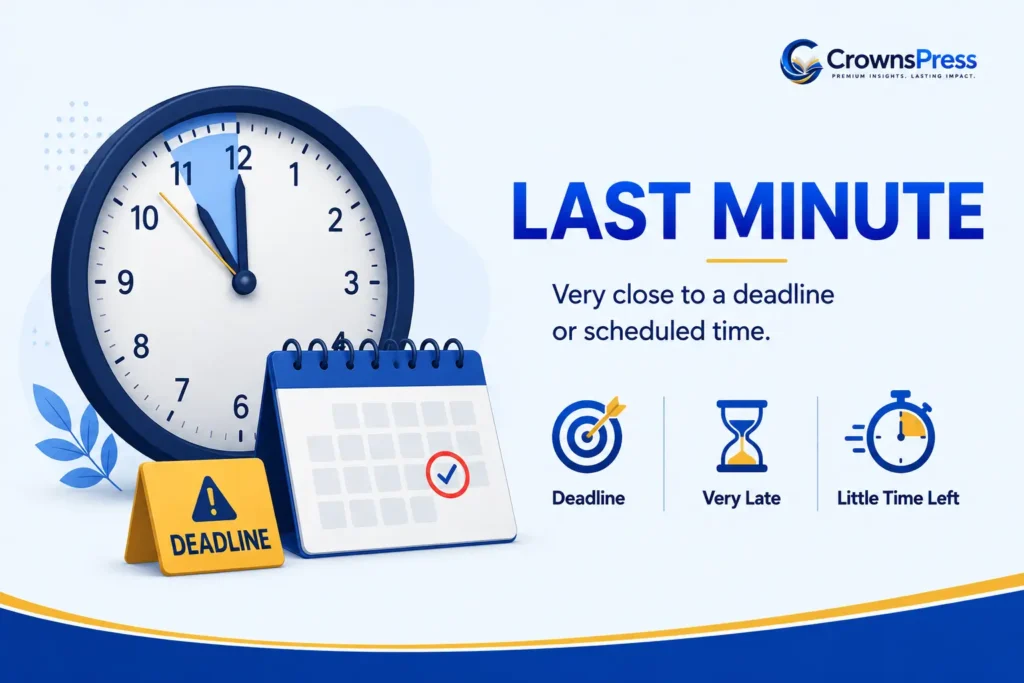
The phrase another way to say last minute refers to different words or expressions that describe something happening very close to a deadline, event, or expected time.
For example, someone might make a decision “at the last moment,” receive a request “on short notice,” or finish a project “at the eleventh hour.” These expressions share a similar idea but can have slightly different tones.
People often search for alternatives to “last minute” because the phrase can become repetitive. Choosing a more specific expression can also make writing sound smoother and better suited to the situation.
You may see these expressions in emails, workplace conversations, school assignments, travel plans, event planning, and everyday American English.
Why Use Other Ways to Say “another way to say last minute”?
Using different expressions can make your communication more precise and natural. Although “last minute” is common and correct, another phrase may better explain why something happened late.
Using alternatives can help you:
- Avoid repeating the same expression.
- Make your writing sound more natural.
- Choose the right level of urgency.
- Communicate professionally in emails and messages.
- Add variety to essays, articles, and conversations.
- Explain whether something was unexpected, delayed, or simply completed near a deadline.
For example, “I received the request at the last minute” is casual and direct. In a professional email, “I received the request on short notice” may sound more polished.
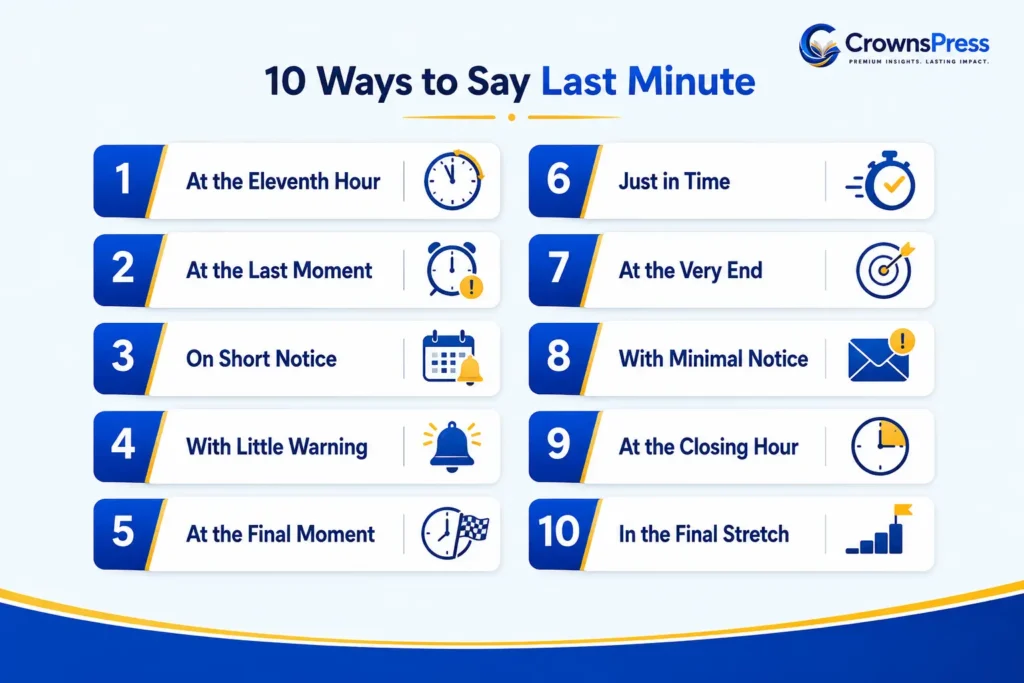
10 Best Other Ways to Say “Last Minute”
1. At the Eleventh Hour
Meaning
“At the eleventh hour” means something happens very close to a deadline or when there is almost no time left. It often suggests urgency and can imply that an action was delayed until the final possible opportunity.
Best For
- Formal
- Professional
- Polite
Example 1
The team reached an agreement at the eleventh hour before the contract expired.
Example 2
She submitted the application at the eleventh hour but still met the deadline.
Quick Tip
Use this expression when you want to emphasize urgency rather than simply say something happened late.
2. At the Last Moment
Meaning
“At the last moment” describes an action, decision, or change that occurs immediately before something is supposed to happen. It is a clear and natural alternative that works in both everyday and professional English.
Best For
- Professional
- Formal
- Casual
Example 1
He changed his presentation topic at the last moment.
Example 2
The airline notified passengers of the gate change at the last moment.
Quick Tip
Choose this phrase when you want a straightforward replacement without adding extra emotion.
3. On Short Notice
Meaning
“On short notice” means someone receives information, a request, or an invitation with very little time to prepare. Unlike some alternatives, it focuses more on the limited preparation time than on a deadline.
Best For
- Professional
- Formal
- Polite
Example 1
Thank you for agreeing to attend the meeting on short notice.
Example 2
Our manager asked me to prepare the report on short notice.
Quick Tip
This is one of the best choices for professional emails because it sounds polite and natural.
4. With Little Warning
Meaning
“With little warning” describes something that happens unexpectedly or with very little advance information. It is especially useful when the short timing was caused by an unexpected change.
Best For
- Professional
- Casual
- Polite
Example 1
The school announced the schedule change with little warning.
Example 2
The event was moved indoors with little warning because of the weather.
Quick Tip
Use this expression when the important point is the lack of advance notice.
5. At the Final Moment
Meaning
“At the final moment” emphasizes that something happened at the very end of an available period. It sounds slightly more formal than the everyday phrase “at the last moment.”
Best For
- Formal
- Professional
Example 1
The negotiators reached a compromise at the final moment.
Example 2
The director approved the revised plan at the final moment.
Quick Tip
Use this phrase when writing formally about decisions, negotiations, deadlines, or major changes.
6. Just in Time
Meaning
“Just in time” means something happens or arrives before it is too late. Unlike “last minute,” it often has a positive feeling because the action successfully avoids a problem.
Best For
- Casual
- Friendly
- Warm
Example 1
We arrived at the theater just in time for the opening scene.
Example 2
She submitted the form just in time to qualify for the program.
Quick Tip
Use “just in time” when the timing worked out successfully rather than focusing on the stress of being late.
7. At the Very End
Meaning
“At the very end” describes something that occurs during the final part of an event, process, period, or deadline. It is simple, conversational, and easy for almost any reader to understand.
Best For
- Casual
- Friendly
- Professional
Example 1
We added the final details at the very end of the project.
Example 2
The speaker answered audience questions at the very end of the session.
Quick Tip
This is a useful choice when you want simple language without suggesting a stressful deadline.
8. With Minimal Notice
Meaning
“With minimal notice” means someone was informed about something with very little advance time. It is more formal than “with little warning” and can work well in workplace or administrative writing.
Best For
- Professional
- Formal
- Polite
Example 1
Employees were asked to attend the training session with minimal notice.
Example 2
The conference venue changed with minimal notice due to construction work.
Quick Tip
Use this expression in formal communication when you want to highlight limited preparation time.
9. At the Closing Hour
Meaning
“At the closing hour” suggests that something happened near the end of a limited period. It has a more formal or literary tone and is less common in casual American conversation.
Best For
- Formal
- Professional
Example 1
The company announced the policy change at the closing hour of the negotiations.
Example 2
The committee approved the proposal at the closing hour before the deadline.
Quick Tip
Use this phrase sparingly because it sounds more formal than everyday alternatives such as “at the last moment.”
10. In the Final Stretch
Meaning
“In the final stretch” means something happens during the last part of a task, project, competition, or period. It does not always mean the absolute final second, so it works best when there is still some time remaining.
Best For
- Casual
- Friendly
- Professional
Example 1
The marketing team made several changes in the final stretch of the campaign.
Example 2
We finished the remaining tasks in the final stretch before the launch.
Quick Tip
Choose this expression when you mean the closing phase rather than one specific final moment.
Comparison Table
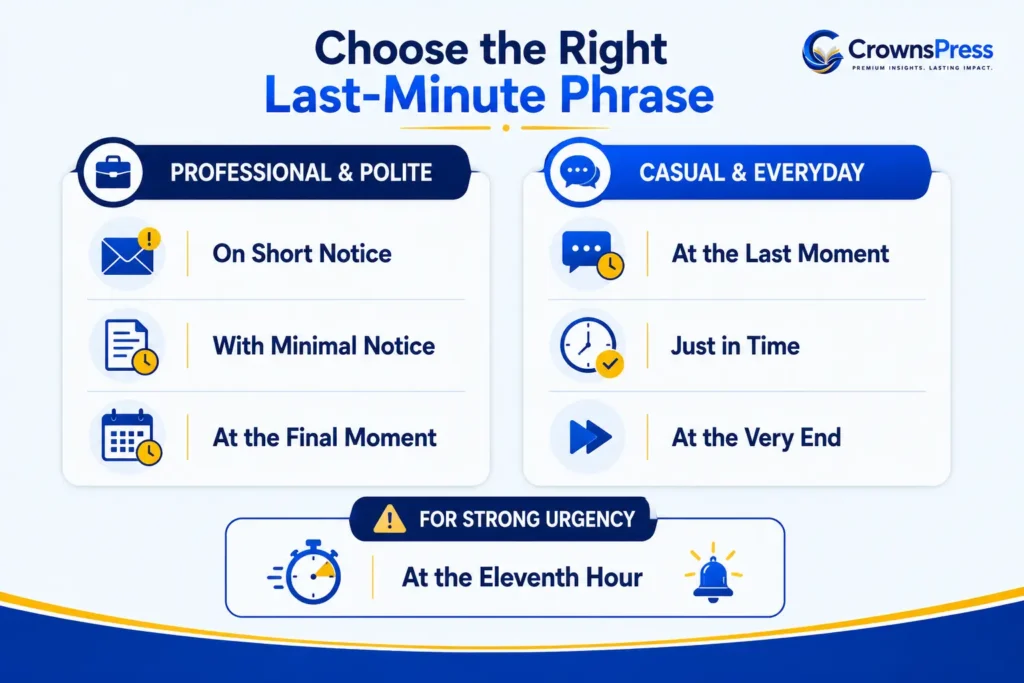
| Alternative | Best Used In | Tone |
| At the eleventh hour | Deadlines, urgent decisions | Formal, urgent |
| At the last moment | General situations | Neutral |
| On short notice | Emails, requests, work | Professional, polite |
| With little warning | Unexpected changes | Neutral |
| At the final moment | Formal decisions | Formal |
| Just in time | Successful timing | Casual, positive |
| At the very end | Events and processes | Casual, neutral |
| With minimal notice | Workplace communication | Formal, professional |
| At the closing hour | Formal situations | Formal |
| In the final stretch | Projects and processes | Casual, professional |
Common Mistakes
1. Using Casual Phrases in Professional Emails
Phrases such as “at the very end” may be perfectly correct but can sound too conversational in some formal situations. “On short notice” is often a better choice for workplace communication.
2. Choosing an Overly Formal Expression
Not every situation requires “at the eleventh hour” or “at the closing hour.” In a simple text message, these expressions may sound unnecessarily dramatic.
3. Ignoring the Difference Between Timing and Notice
“On short notice” usually focuses on having little preparation time. “At the last moment” focuses on when an action occurred. Choosing based on this difference makes your writing more precise.
4. Using “Just in Time” When Something Was Actually Late
“Just in time” generally suggests that something happened before it was too late. If the action missed a deadline, another expression would be more accurate.
5. Forgetting the Context
The best alternative depends on the situation. A professional email, casual conversation, deadline, travel plan, and unexpected change may each call for a different expression.
Frequently Asked Questions
What is another way to say “last minute”?
Common alternatives include “at the eleventh hour,” “at the last moment,” “on short notice,” “with little warning,” and “just in time.” The best choice depends on what you want to emphasize. Use “on short notice” when someone had little time to prepare and “at the last moment” when something happened very close to the deadline.
What is a professional way to say “last minute”?
“On short notice” is one of the most natural professional alternatives. For example, you could write, “Thank you for handling this request on short notice.” It sounds polite and focuses on the limited preparation time without making the situation sound careless or overly dramatic.
What is another word for “last minute” in an email?
In a professional email, you can use “on short notice,” “with little warning,” or “at the last moment,” depending on the meaning. “On short notice” works particularly well when someone has been asked to do something without much advance preparation.
Is “at the eleventh hour” the same as “last minute”?
“At the eleventh hour” has a similar meaning, but it usually carries a stronger sense of urgency. It suggests that something happened very close to a deadline or when there was almost no time remaining. “Last minute” is more common and neutral in everyday American English.
How do you politely say “last minute”?
You can say “on short notice” when speaking politely, especially in professional situations. For example, “I appreciate your help with this on short notice” sounds courteous and recognizes that the other person had limited time to prepare.
What is a casual way to say “last minute”?
Casual alternatives include “at the last moment,” “at the very end,” and “just in time.” The best option depends on your meaning. “Just in time” has a positive tone, while “at the last moment” simply describes something that happened very late.
Can I use “last minute” in formal writing?
Yes. “Last minute” is standard English and can appear in formal writing, especially when it is used as a compound adjective, such as “a last-minute change.” However, a more specific alternative may make formal writing clearer and more polished.
What is the difference between “last minute” and “short notice”?
“Last minute” usually describes timing close to a deadline or event. “Short notice” focuses on how little advance information someone received. For example, a meeting can be scheduled on short notice even if it is not happening immediately, while a last-minute decision occurs very close to the final deadline or event.
Conclusion
There are many useful alternatives to another way to say last minute, but the right choice depends on context. “On short notice” is ideal for professional emails and workplace requests, while “at the eleventh hour” works when you want to stress urgency. For a clear definition, see the definition of last minute.
If the timing was successful, “just in time” gives the sentence a more positive meaning. For unexpected changes, “with little warning” may be more accurate, while “in the final stretch” works when you mean the closing stage of a longer process.
The key is to choose an expression that matches both the situation and your intended tone. A precise alternative makes your writing clearer, more natural, and easier to understand.
Another way to say last minute depends on the context. Common alternatives include at the eleventh hour, at the last moment, on short notice, with little warning, at the final moment, and just in time. For professional writing, “on short notice” often sounds more natural, while “at the eleventh hour” adds emphasis.