If you need another way to say “in this paper,” choose a phrase that fits your academic context. Common alternatives include “in this study,” “this paper examines,” “this article discusses,” “the present study,” and “this research explores.” These options can reduce repetition while making academic writing clearer, more precise, and natural.
Key Takeaways
- “In this paper” is correct, but repeating it can make academic writing sound mechanical.
- “In this study” works well when discussing research methods, findings, or results.
- “This paper examines” is useful when introducing the main focus or research question.
- Formal options such as “the present study” suit scholarly and research-heavy writing.
- Choose an alternative based on meaning, context, tone, and what you want the sentence to accomplish.
What Does “Another Way to Say In This Paper” Mean?
The phrase “another way to say in this paper” refers to alternative expressions you can use instead of “in this paper” in academic writing. Writers often look for these alternatives when they want to avoid repetition or make a sentence sound more precise.
“In this paper” commonly appears in essays, research papers, journal articles, dissertations, and academic reports. For example, a writer might say, “In this paper, we examine the effects of social media on college students.”
The phrase is grammatically acceptable, but repeating it several times can make your writing feel predictable. Choosing a more specific expression can improve flow and clarify whether you are discussing the study, research, argument, method, or findings.
Why Use Other Ways to Say “In This Paper”?
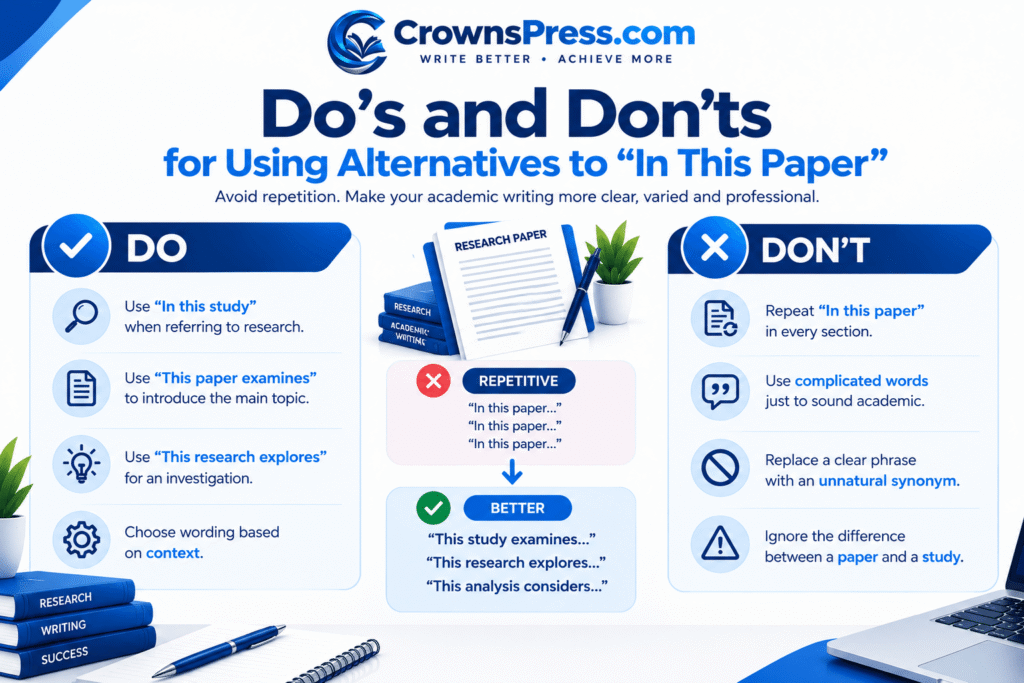
Using alternatives does more than make your vocabulary varied. The right phrase can also tell readers exactly what part of your academic work you are discussing.
Consider using another expression to:
- Avoid unnecessary repetition.
- Make academic writing sound more natural.
- Introduce your research focus more directly.
- Match the formality of your paper.
- Describe a study, argument, method, or finding more precisely.
- Improve sentence variety and readability.
The key is not to replace “in this paper” every time it appears. If the original phrase is the clearest choice, keep it.
10 Best Other Ways to Say “In This Paper”
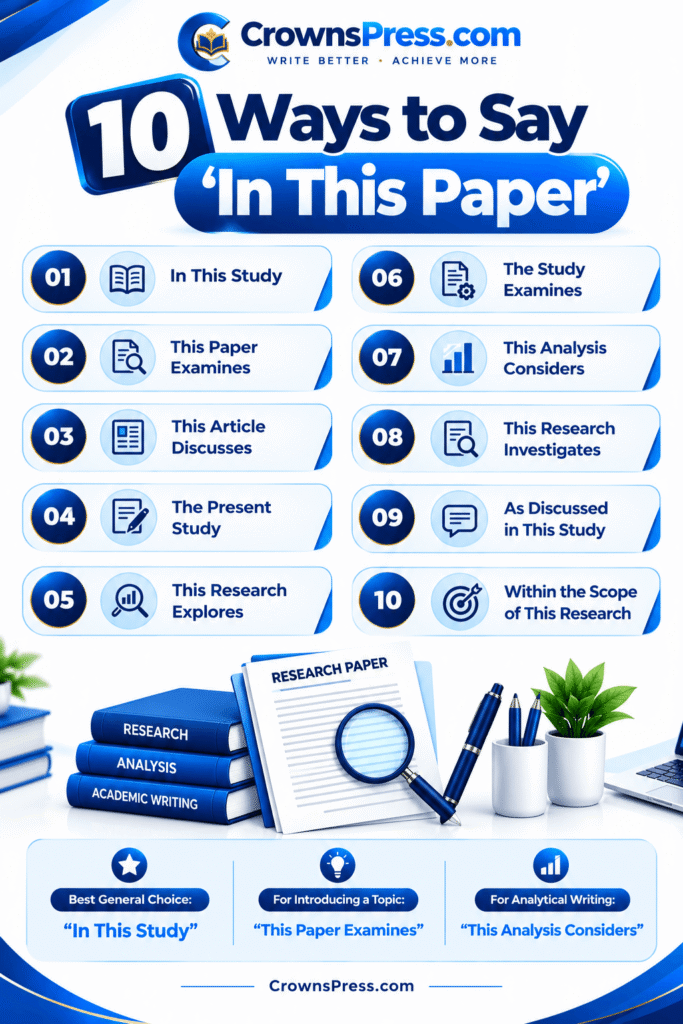
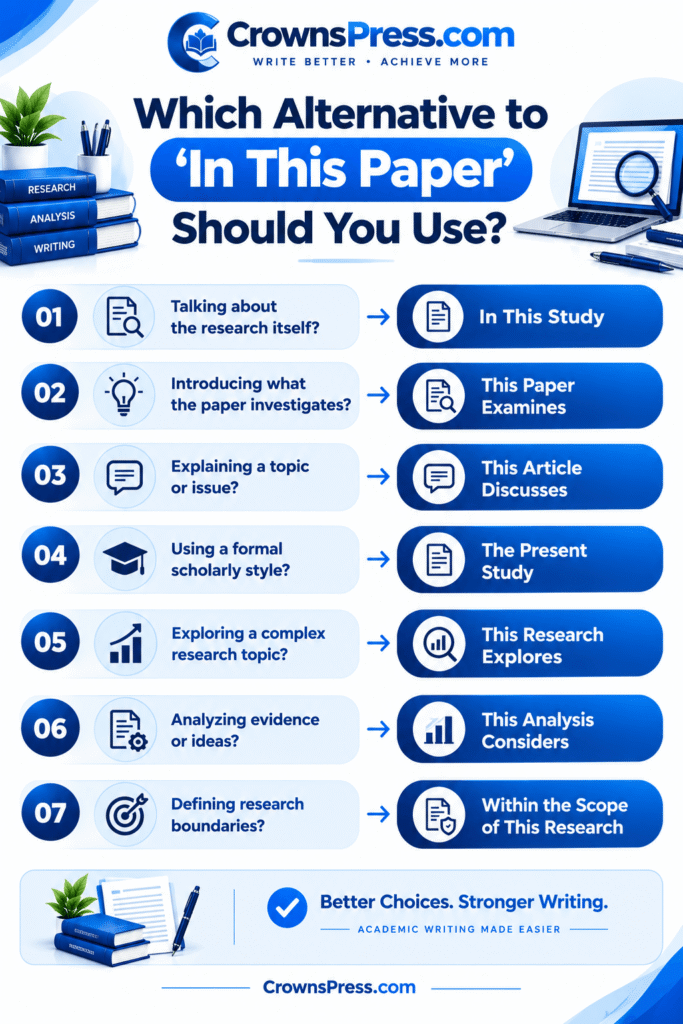
1. In This Study
Meaning
“In this study” emphasizes the research itself rather than the physical paper or document. It is especially appropriate when discussing research questions, participants, methods, data, results, or conclusions.
Best For
- Professional
- Formal
- Academic
Example 1
In this study, researchers examined how sleep patterns affected college students’ academic performance.
Example 2
In this study, we analyzed responses from more than 500 survey participants.
Quick Tip
Use “in this study” when your sentence focuses on the research process or findings.
2. This Paper Examines
Meaning
“This paper examines” directly introduces the subject or issue that the paper investigates. It creates a stronger, more active opening than simply saying what happens “in this paper.”
Best For
- Formal
- Professional
Example 1
This paper examines the relationship between remote work and employee productivity.
Example 2
This paper examines how public transportation policies influence urban development.
Quick Tip
Use this phrase when you want to state your paper’s central topic clearly and immediately.
3. This Article Discusses
Meaning
“This article discusses” works well when your writing explains, evaluates, or presents information about a particular subject. It is common in scholarly articles, professional publications, and analytical writing.
Best For
- Professional
- Formal
Example 1
This article discusses the challenges faced by first-generation college students.
Example 2
This article discusses several approaches to improving workplace communication.
Quick Tip
Choose “discusses” when the goal is explanation or analysis rather than reporting the results of an original experiment.
4. The Present Study
Meaning
“The present study” is a formal academic expression that refers to the research being reported. It helps create a scholarly tone without repeatedly using “this paper” or “this study.”
Best For
- Formal
- Professional
Example 1
The present study evaluates the effectiveness of a six-week reading intervention.
Example 2
The present study focuses on communication patterns among healthcare professionals.
Quick Tip
Use this option sparingly if your paper already contains many formal phrases; too much repetition can make your writing feel stiff.
5. This Research Explores
Meaning
“This research explores” emphasizes an investigation into a topic, relationship, question, or problem. The verb “explores” is useful when the research is examining an issue without suggesting a predetermined conclusion.
Best For
- Professional
- Formal
Example 1
This research explores how neighborhood design affects residents’ physical activity.
Example 2
This research explores the experiences of employees adapting to hybrid workplaces.
Quick Tip
Use “explores” when your research investigates a complex or developing topic.
6. The Study Examines
Meaning
“The study examines” provides a direct way to describe what the research investigates. It sounds objective and works particularly well in research-focused writing.
Best For
- Formal
- Professional
Example 1
The study examines whether smaller class sizes improve student engagement.
Example 2
The study examines differences in consumer behavior across age groups.
Quick Tip
This phrase is a strong choice when you want to focus attention on the research rather than the document.
7. This Analysis Considers
Meaning
“This analysis considers” is useful when your work evaluates evidence, ideas, arguments, trends, or data. It highlights the analytical nature of the writing.
Best For
- Formal
- Professional
Example 1
This analysis considers the economic factors behind rising housing costs.
Example 2
This analysis considers how language choices influence readers’ perceptions of a message.
Quick Tip
Use this expression for analytical essays, literature reviews, policy papers, and other work centered on evaluation.
8. This Research Investigates
Meaning
“This research investigates” has a stronger investigative tone than “discusses” or “considers.” It suggests that the research closely examines a question, problem, relationship, or phenomenon.
Best For
- Formal
- Professional
Example 1
This research investigates the causes of employee turnover in small businesses.
Example 2
This research investigates whether digital reminders improve medication adherence.
Quick Tip
Use “investigates” when your research actively seeks answers to a defined research question.
9. As Discussed in This Study
Meaning
“As discussed in this study” refers back to information, ideas, or findings already presented. It is useful when connecting a current statement to an earlier section of the research.
Best For
- Formal
- Polite
Example 1
As discussed in this study, access to reliable transportation can affect employment opportunities.
Example 2
As discussed in this study, early feedback can improve students’ understanding of complex concepts.
Quick Tip
Use this phrase for cross-references, but avoid it when a direct statement would be clearer.
10. Within the Scope of This Research
Meaning
“Within the scope of this research” emphasizes the boundaries of the investigation. It is particularly useful when explaining what your research covers and what falls outside its focus.
Best For
- Formal
- Professional
Example 1
Within the scope of this research, only public universities were included in the analysis.
Example 2
Within the scope of this research, the study focused on short-term changes in consumer behavior.
Quick Tip
Use this expression when you need to define or clarify the limits of your research.
Comparison Table
| Alternative | Best Used In | Tone |
|---|---|---|
| In this study | Research papers, academic reports | Formal |
| This paper examines | Research introductions | Formal |
| This article discusses | Academic and professional articles | Professional |
| The present study | Scholarly research | Formal |
| This research explores | Research and academic analysis | Formal |
| The study examines | Research findings and objectives | Formal |
| This analysis considers | Analytical papers and essays | Professional |
| This research investigates | Empirical research | Formal |
| As discussed in this study | Cross-references | Formal |
| Within the scope of this research | Research limitations and boundaries | Formal |
Common Mistakes
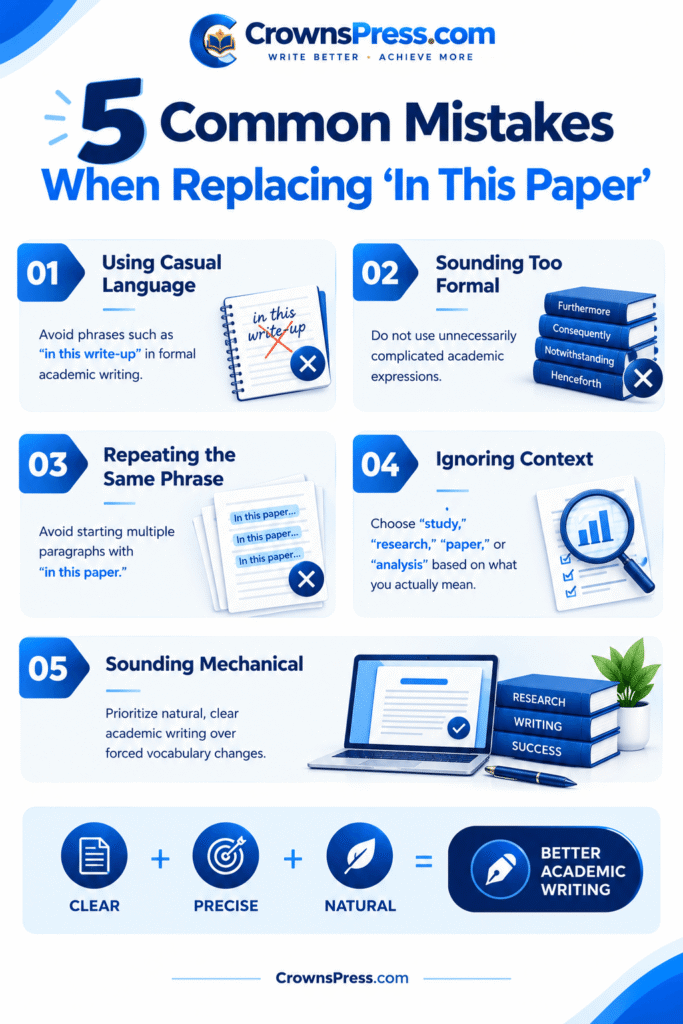
1. Using Casual Phrases in Academic Writing
Expressions such as “in this write-up” or “in this piece” may sound too informal for a research paper. Choose terminology that matches the academic setting.
2. Choosing Overly Formal Language
Not every sentence needs a phrase such as “within the scope of the present investigation.” Simple wording is often clearer and more effective.
3. Repeating the Same Phrase
Using “in this paper” in every section can make your writing repetitive. Vary your sentence structure when doing so improves clarity.
4. Forgetting Context
Not every alternative has the same meaning. For example, “this study” refers to research, while “this analysis” emphasizes evaluation and interpretation.
5. Sounding Insincere or Mechanical
Academic writing should remain clear and natural. Replacing ordinary language with complicated expressions simply to sound scholarly can make your work harder to read.
Frequently Asked Questions
1. What is another way to say “in this paper”?
Common alternatives include “in this study,” “this paper examines,” “this article discusses,” “the present study,” and “this research explores.” The best choice depends on what you are describing. Use “in this study” for research-related content and “this paper examines” when introducing the paper’s main focus.
2. Is “in this paper” grammatically correct?
Yes, “in this paper” is grammatically correct and widely used in academic writing. However, repeating it too often can make your prose sound repetitive. You can improve sentence variety by using more specific alternatives, such as “this study examines” or “this analysis considers,” when they accurately describe your meaning.
3. What is a formal way to say “in this paper”?
“The present study” is a formal alternative, while “this study” is formal but more natural for most academic writing. “Within the scope of this research” is also formal, but it should be reserved for sentences that discuss the boundaries or focus of the research.
4. Can I use “in this study” instead of “in this paper”?
Yes. “In this study” is often a better choice when you are talking about research methods, participants, data, findings, or conclusions. However, the two phrases are not always interchangeable because “paper” refers to the document, while “study” refers to the research itself.
5. How can I avoid saying “in this paper” repeatedly?
Change the sentence structure rather than simply replacing the phrase every time. For example, instead of “In this paper, we examine workplace stress,” write “This study examines workplace stress.” This approach usually sounds more direct and reduces unnecessary introductory wording.
6. Is “this paper discusses” good academic writing?
Yes, “this paper discusses” is acceptable academic writing. However, a more precise verb can make the sentence stronger. Depending on your purpose, you could use “this paper examines,” “this research investigates,” or “this analysis considers” to explain exactly what the paper does.
7. Should I use “this paper” or “this study”?
Use “this paper” when referring to the document, argument, structure, or content of the paper. Use “this study” when referring to the actual research, including its participants, methods, data, results, or findings. Choosing the correct term makes your academic writing more precise.
8. What is the best alternative to “in this paper”?
For most research writing, “in this study” is the strongest general alternative because it sounds natural and clearly refers to the research. If you are introducing the paper’s purpose, however, “this paper examines” may be better because it states the subject directly.
Conclusion
Finding another way to say “in this paper” can make academic writing more varied, precise, and natural. The best alternative depends on what you are actually discussing. “In this study” is ideal for research methods and findings, while “this paper examines” works well for introducing a central topic. For formal scholarly writing, “the present study” can provide a more traditional tone.
You do not need to avoid “in this paper” completely. It is correct when it accurately describes your meaning. Instead, focus on choosing the phrase that gives readers the clearest information with the fewest unnecessary words. A useful rule is simple: refer to the paper when discussing the document, and refer to the study or research when discussing the investigation itself.